Interactive live sessions for concept clarity, plus 24/7 access to HD recordings so students never miss a lesson.
We move beyond rote memorization. Our teaching method emphasizes "the why" and "the how" to solve complex problems.
Syllabus structured specifically for NEET . Regular mock tests and previous year question (PYQ) analysis.
Students shouldn't get stuck. Dedicated doubt-clearing sessions and peer groups to ensure continuous progress.
Concise notes, formula sheets, and mind maps designed to make revision quick and effective before exams.
Monthly progress reports for parents. We track strengths and weaknesses to personalize the improvement plan.
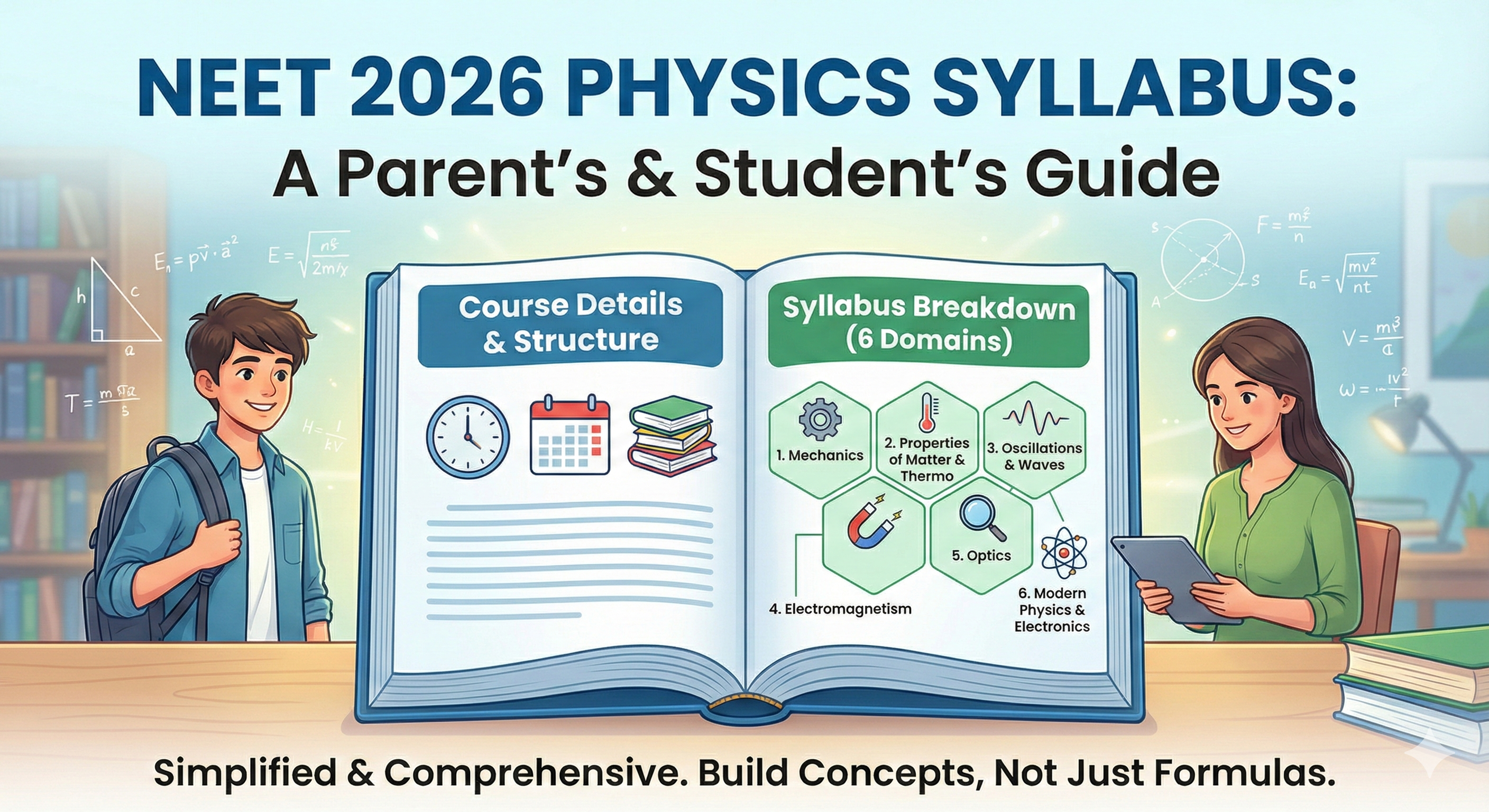
Overview for Parents & Aspirants: Physics in NEET is not just about memorizing formulas; it is about understanding how the universe works—from the smallest atoms to the movement of planets. This syllabus covers the complete 2-year curriculum (Class 11 and 12), categorized here into six core domains to help you visualize the scope of study.
This section forms the bedrock of Physics. It deals with measurement, motion, forces, and gravity. A strong grasp here is essential for understanding the rest of the syllabus.
Unit I: Physics and Measurement
Foundational concepts: SI units, significant figures, and dimensional analysis.
Accuracy: Understanding errors in measurement and using instruments like Vernier Calipers.
Unit II: Kinematics (Motion)How objects move: Speed, velocity, and acceleration.
Visualizing motion: Position-time and velocity-time graphs.
Unit III: Laws of Motion
Newton’s three laws: Inertia, momentum, and reaction forces.
Friction: Static, kinetic, and rolling friction.
Circular motion: How vehicles turn on level and banked roads.
Unit IV: Work, Energy, and Power
The relationship between work and energy (Kinetic & Potential).
Collisions: Elastic and inelastic collisions.
Conservation laws: How energy is preserved in mechanical systems.
Unit V: Rotational Motion
Center of mass and torque.
Moment of inertia and equilibrium of rigid bodies.
Unit VI: Gravitation
Universal laws of gravity and Kepler’s laws of planetary motion.
Satellite mechanics: Orbital velocity, escape velocity, and satellite energy.
This domain explores how matter behaves under stress and heat. It is critical for understanding fluids, gases, and energy transfer.
Unit VII: Properties of Solids and Liquids
Solids: Elasticity, Stress-strain relationships, and Hooke's Law.
Fluids: Pascal’s law (hydraulics), viscosity, and Bernoulli’s principle (fluid flow).
Surface Tension: Why drops are spherical; capillary rise.
Unit VIII: Thermodynamics
Laws of Thermodynamics: Zeroth, First, and Second laws.
Processes: Isothermal (constant temperature) and Adiabatic (no heat exchange) processes.
Heat Engines: Efficiency and refrigerator principles.
Unit IX: Kinetic Theory of Gases
Behavior of gases: Ideal gas equations and assumptions.
Molecular level: RMS speed, degrees of freedom, and the law of equipartition of energy.
The study of repetitive motion and sound. This connects mechanics to wave optics.
Unit X: Oscillations and Waves
Simple Harmonic Motion (SHM): Pendulums and spring systems.
Wave Motion: Sound waves, speed of waves, and the Doppler effect.
Superposition: Beats, standing waves in organ pipes and strings.
A major weightage area covering electricity, magnetism, and their interplay. This is the core of the Class 12 syllabus.
Unit XI: Electrostatics
Electric charges, Coulomb’s law, and Electric Fields.
Gauss’s Law applications (calculating fields for shells and wires).
Capacitors: Storing energy, dielectrics, and circuit combinations
Unit XII: Current Electricity
Ohm’s Law, drift velocity, and resistivity.
Circuit analysis: Kirchhoff’s laws, Wheatstone bridge, and Potentiometer.
Unit XIII: Magnetic Effects of Current
Biot-Savart Law and Ampere’s Law.
Force on moving charges (Lorentz force) and Cyclotrons.
Magnetism: Bar magnets, magnetic dipoles, and Earth’s magnetism.
Unit XIV: Electromagnetic Induction & AC
Faraday’s and Lenz’s Law (how electricity is generated).
Alternating Current (AC): LCR circuits, resonance, transformers, and generators.
Unit XV: Electromagnetic Waves
The spectrum: Radio waves to Gamma rays and their applications.
The study of light, mirrors, lenses, and optical instruments.
Unit XVI: Optics
Ray Optics: Reflection, Refraction, Mirrors, and Lenses.
Optical Instruments: Microscopes and Telescopes (magnifying powers).
This section covers 20th-century physics breakthroughs, including atoms, nuclear energy, and semiconductors.
Unit XVII: Dual Nature of Matter
Photoelectric effect and Einstein’s equation.
De Broglie relation (wave nature of particles).
Unit XVIII: Atoms and Nuclei
Bohr’s model of the atom and Hydrogen spectrum.
Nuclear Physics: Fission, Fusion, and Mass-energy relation ()
Unit XIX: Electronic Devices
Semiconductors: Diodes, Rectifiers, and LEDs.
Logic Gates: The building blocks of digital electronics (AND, OR, NOT, NAND, NOR).
NEET emphasizes practical application. Students are expected to be familiar with the following experiments:
Unit XX: Experimental Skills
Precision Instruments: Using Vernier Calipers and Screw Gauges.
Mechanics: Determining 'g' using a simple pendulum; measuring surface tension and viscosity.
Thermal: Measuring specific heat capacity.
Electricity: Using Metre Bridge and Potentiometer for resistance measurements.
Optics: Finding focal lengths of mirrors/lenses and refractive indices.
To master this syllabus, the following resources are highly recommended by experts:
NCERT Textbooks (Class 11 & 12): The absolute bible for NEET Physics.
Concepts of Physics (H.C. Verma): Excellent for conceptual clarity.
Objective Physics (D.C. Pandey or MTG): Essential for practicing multiple-choice questions (MCQs).
Fundamentals of Physics (Halliday, Resnick, Walker): For deeper theoretical understanding.
Month 1: Fundamentals & Kinematics Focus: Building the mathematical foundation and understanding motion. Topics: Unit I: Physics and Measurement (Units, Dimensions, Errors). Unit II: Kinematics (Motion in a Straight Line, Projectile Motion, Relative Velocity). Skills: Graph analysis (Position-Time, Velocity-Time). Month 2: Mechanics of Force & Energy Focus: Core dynamic principles governing movement and energy. Topics: Unit III: Laws of Motion (Newton’s Laws, Friction, Circular Motion). Unit IV: Work, Energy, and Power (Collisions, Conservation of Energy). Month 3: Rigid Bodies & Gravity Focus: Complex mechanical systems and planetary motion. Topics: Unit V: Rotational Motion (Torque, Moment of Inertia, Rolling Motion). Unit VI: Gravitation (Kepler’s Laws, Satellite Mechanics). Month 4: Properties of Matter & Heat Focus: Understanding material behavior and thermal energy. Topics: Unit VII: Properties of Solids and Liquids (Elasticity, Viscosity, Surface Tension). Unit VIII: Thermodynamics (Laws of Thermodynamics, Heat Engines). Unit IX: Kinetic Theory of Gases. Month 5: Oscillations, Waves & Electrostatics (Start) Focus: Periodic motion and the beginning of Class 12 topics. Topics: Unit X: Oscillations (Simple Harmonic Motion) and Waves (Sound, Doppler Effect). Unit XI: Electrostatics Part 1 (Electric Charges, Fields, Gauss’s Law). Month 6: Electrostatics & Current Electricity Focus: Heavy-weight electrical concepts. Topics: Unit XI: Electrostatics Part 2 (Electric Potential, Capacitors, Dielectrics). Unit XII: Current Electricity (Ohm’s Law, Kirchhoff’s Laws, Electrical Instruments). Month 7: Magnetism & Induction Focus: Magnetic effects of current and AC circuits. Topics: Unit XIII: Magnetic Effects of Current and Magnetism (Biot-Savart Law, Moving Coil Galvanometer). Unit XIV: Electromagnetic Induction and Alternating Current (Lenz's Law, LCR Circuits). Unit XV: Electromagnetic Waves. Month 8: Optics (Ray & Wave) Focus: Light properties and optical instruments. Topics: Unit XVI: Ray Optics (Mirrors, Lenses, Prisms, Telescopes/Microscopes). Unit XVI: Wave Optics (Interference, Diffraction, Polarization). Month 9: Modern Physics & Electronics Focus: High-scoring, conceptual topics from 20th-century physics. Topics: Unit XVII: Dual Nature of Matter (Photoelectric Effect). Unit XVIII: Atoms and Nuclei (Bohr Model, Radioactivity, Fission/Fusion). Unit XIX: Electronic Devices (Semiconductors, Logic Gates). Month 10: Final Revision & Mock Tests Focus: Exam simulation and strengthening weak areas. Activities: Full Syllabus Mock Tests. Previous Year Question (PYQ) analysis. Rapid formula revision for all units.