
Exam-Centric Summary: PN Junction & Zener Diode
09 Jan 20261. Key Definitions (1-Mark Questions)
-
Diffusion: The movement of charge carriers from a region of higher concentration to lower concentration (Electrons: N → P, Holes: P → N).
-
Depletion Region: A layer formed near the junction containing immobile ions (Positive ions on N-side, Negative ions on P-side). It is void of free charge carriers.
-
Barrier Potential: The internal electric field developed across the depletion region that opposes further diffusion of carriers.
-
Drift Current: The small current caused by the electric field sweeping minority carriers across the junction (opposite direction to diffusion).
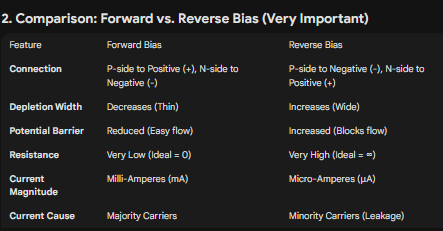
3. The I-V Characteristics Graph
You must be able to draw and label this graph.
-
Knee Voltage (Cut-in Voltage): The forward voltage at which current starts increasing rapidly.
-
Silicon (Si): ~0.7 V
-
Germanium (Ge): ~0.3 V
-
-
Breakdown Voltage: The reverse voltage at which the current increases sharply. Operating beyond this destroys a normal diode, but a Zener diode is designed for it.
4. Zener Diode (Reasoning & Application)
-
Symbol: Standard diode symbol with a 'Z' bend on the vertical line.
-
Doping Level: Heavily Doped.
-
Reasoning Question: Why heavy doping?
-
Answer: Heavy doping creates a very thin depletion layer, allowing the electric field to become strong enough to cause breakdown at low voltages without damaging the diode.
-
-
Mode of Operation: Always connected in Reverse Bias.
-
Application: Voltage Regulator.
-
It is connected in Parallel to the load.
-
If input voltage > Zener Breakdown Voltage (Vz), the Zener diode conducts the extra current, keeping the voltage across the load constant.
-